
Buy .455 Webley Ammo for Sale
(0)
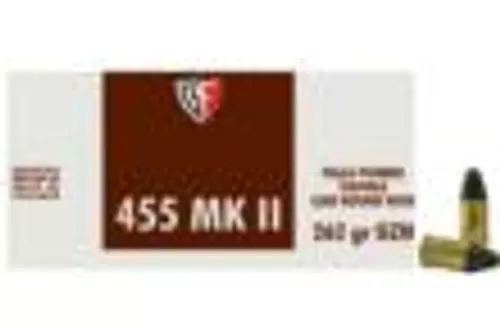
Fiocchi Ammo .455 Webley - 262gr. Lead-rn 50-pack
Brand:
Fiocchi
Bullet Type:
Lead Round Nose
Caliber:
.455 Webley
Grains:
262 grain
Rounds:
50


Frequently Asked Questions
Buy .455 Webley Ammo for Sale
Is .455 Webley still made?
Yes. Several manufacturers still produce .455 Webley ammunition, including Fiocchi and various specialty loaders. It remains available through online retailers and gun shows, though supply is limited and prices are higher than common calibers. Vintage ammunition also surfaces occasionally at auction.
How much is a Webley .455 worth?
Webley revolvers in .455 vary by condition and model. The Mk VI averages around $1,012.72 used, while the Mk I averages around $1,324.12, with retail listings near $1,399.99. Parts guns and accessories cost considerably less and may skew lower-end listings significantly.
How powerful is .455 Webley?
.455 Webley fires a 262-grain bullet at roughly 650–700 fps, generating around 250 ft-lbs of muzzle energy. That's modest by modern standards but comparable to .45 ACP. The large, slow bullet was considered an effective manstopper during its service life from the 1880s through World War II.
Can you shoot 45 ACP in 455 Webley?
No. Standard .45 ACP runs 21,000 psi, far exceeding the .455 Webley's 13,050 psi design limit. Firing it risks cylinder failure. Some Webleys were shaved post-WWII to accept .45 ACP with moon clips, but even standard factory .45 ACP loads are considered too hot for these conversions, equivalent to proof loads.
Is 455 Colt the same as 455 Webley?
Not quite. .455 Colt matches .455 Webley Mark I cordite specs, while .455 Webley Mark II uses a shorter case. Both fire the same 265-grain bullet at similar velocities, but Mark II ammunition is the correct round for Mark II through VI Webley revolvers.
When was 455 Webley made?
The .455 Webley cartridge was introduced in 1891 as Britain's standard military sidearm round. The Webley Mark VI revolver chambered in this caliber entered production in 1915, not 1902. The cartridge remained in service use through World War II.